- English


Gold Outlook: A September Hike Is Priced In — Forward Guidance Is What Matters Now
.jpg?height=93&quality=30)
Gold extended the downtrend that's been in place since late August. Escalating geopolitical tensions drove oil prices sharply higher, while U.S. PPI and CPI both pointed to sticky inflation. Together, these pushed up pricing for a September Fed hike and weighed on gold. As fresh developments out of the Middle East continued rolling in since Friday, gold has been repricing around them.
Heading into this week, the FOMC meeting is the event markets are watching most closely. With traders already fully pricing in a hike, the real question isn't whether the Fed moves — it's how policymakers choose to frame the path forward.
Technical Observation: Range-Bound Trading Continues — Waiting for the Fed to Break the Deadlock
On the XAUUSD daily chart, gold traded lower over the past week in a choppy pattern. Having lost the $4,400 level, price is still finding support at $4,300. A convincing breakout from the $4,300–$4,400 range looks unlikely before Wednesday's Fed statement, and traders may want to avoid taking large directional bets until then.
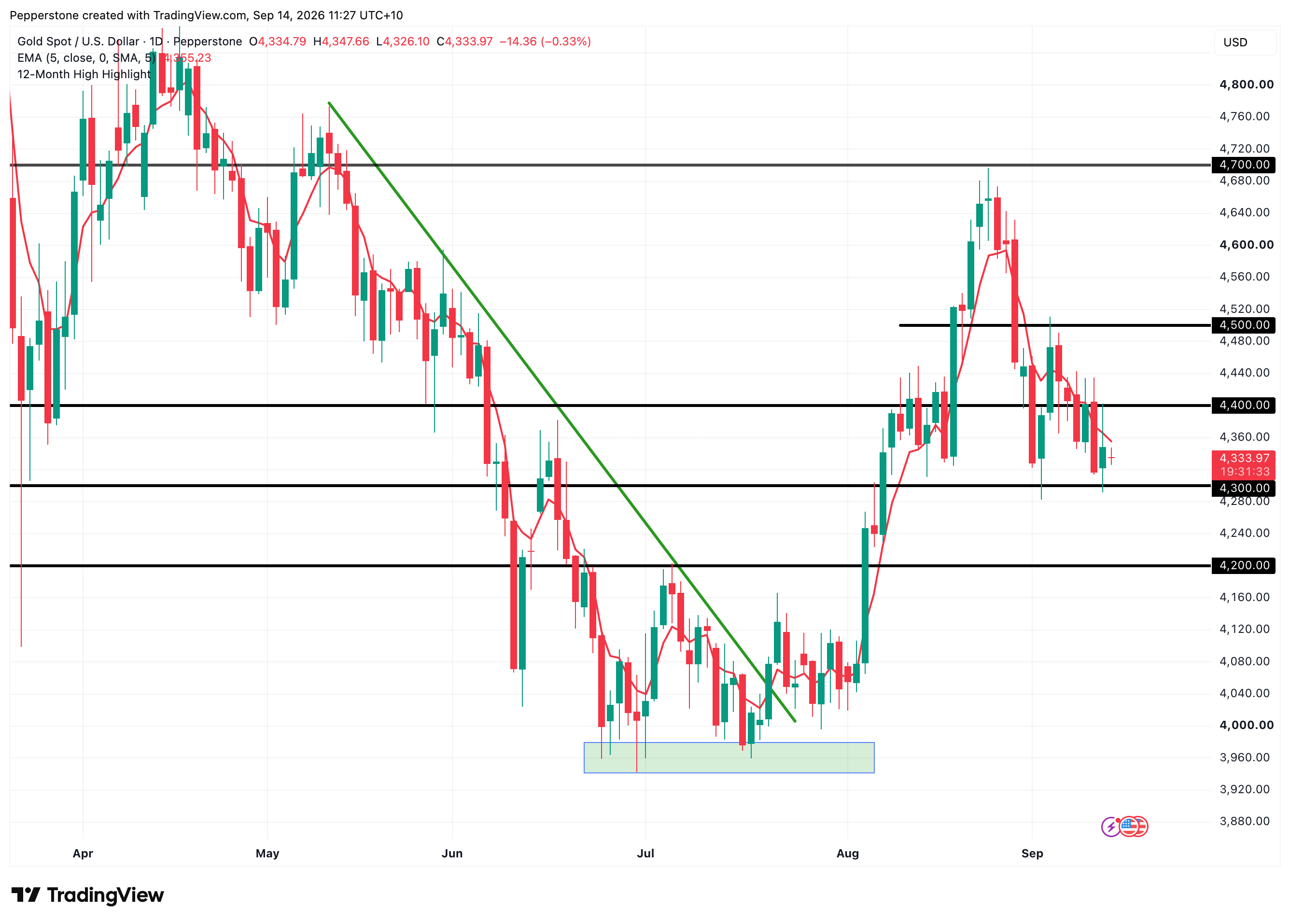
In the near term, a daily close below $4,300 would suggest bears are gaining further control, opening the door toward $4,200 and potentially $4,000. Conversely, a decisive break above $4,400 would suggest the market is starting to treat this hike as a "sell the rumor, buy the fact" event, with buyers likely to return and push gold toward a test of $4,500.
Geopolitics and Oil: $100 Sets the Backdrop for the Inflation Trade
Oil's rapid push through $100 has been one of the key drivers behind gold's recent weakness.
Attacks on Saudi oil infrastructure last week, along with worsening conditions for shipping through the Strait of Hormuz, have deepened concerns that the situation is drifting toward something more prolonged. Fears of a supply disruption have grown, which has weighed on gold.
Oil then pulled back on news of fresh diplomatic efforts, helping gold stabilize. However, reports that Saudi Arabia had shut down a pipeline used to bypass the Strait of Hormuz, combined with the postponement of talks between Iran and Gulf states, pushed oil higher again in early Monday trading.
As long as the conflict keeps disrupting expectations around energy supply and keeps oil above $100, rising inflation could continue to reinforce expectations of Fed tightening — a headwind for gold.
FOMC Meeting: A Hike Is Largely Baked In — Markets Await the Path Forward
August's headline CPI rose 0.4% month-on-month, with core CPI up 0.3% — both above the prior readings. Combined with the earlier upside surprises in PPI and payrolls, markets are now pricing roughly an 86% probability of a 25 basis point September hike, keeping gold under pressure.
Given how fully the market has already priced this in, if the Fed simply delivers what's expected, the shock of the "shoe dropping" could turn out to be milder than some traders expect.
More importantly, this round of CPI upside surprises was largely driven by oil pass-through and AI-chip-shortage-related price increases in hardware — not broad-based overheating in the economy. A supply shock originating from the Strait of Hormuz isn't something a rate hike can fix directly.
If the market comes to see this inflation episode as supply-driven rather than a sign of overheating U.S. demand, a single hike may end up having a more limited impact on the Fed's forward path than a genuinely sustained inflation resurgence would.
Add in the approaching midterm elections and mounting fiscal pressure, and if markets treat this hike as a one-off move, the downside pressure on gold could be relatively contained.
In other words, what matters for gold's next move isn't whether the Fed hikes in September — it's what signal follows: a period on hold, or the start of a renewed tightening cycle.
- The base case: a 25bp hike, with Warsh stopping short of any firm commitment on the next move. If that's the outcome, gold could see short-term pressure right after the decision, but buyers are likely to return as the market reassesses how much more tightening is actually on the table.
- The bigger risk: Warsh strikes a clearly hawkish tone, reiterating that controlling inflation remains the top priority and leaving the door open for an October hike. If the 10-year yield pushes back toward 5% in that scenario, gold could test $4,200 or lower.
- The true wildcard: no hike at all this week. This is a very low-probability outcome, but if inflation remains elevated and the Fed backs off anyway, it could trigger a repricing of the Fed's policy credibility — in which case gold and bonds could rally sharply together.
On balance, gold is likely to stay rangebound heading into the decision, with a genuine directional break only likely to emerge once the forward guidance is revealed. The hike itself is old news — what the market is really trading is the Fed's tone on what comes next.
Watch the Bank of Japan and Geopolitical Risk
Overall, gold looks set to remain rangebound and under pressure in the near term, buffeted by both geopolitical developments and shifting rate-hike pricing. The Fed's decision — and Warsh's guidance on the path ahead in particular — remains the central driver of gold's next move.
Beyond that, this week also brings rate decisions from the Bank of England and the Bank of Japan, along with a cluster of inflation and employment data from the U.S., Europe, and the UK. The BoE is expected to hold steady, while the BoJ is expected to hike by 25 basis points. Developments around the Strait of Hormuz are also worth watching.
If inflation continues to run hot broadly, major central banks move to tighten in tandem, and there's no meaningful breakthrough on the geopolitical front, gold's near-term downside could deepen further. That said, continued central bank buying and the broader debasement trade remain in place — and could still provide a floor for gold over the medium to long term.
The material provided here has not been prepared in accordance with legal requirements designed to promote the independence of investment research and as such is considered to be a marketing communication. Whilst it is not subject to any prohibition on dealing ahead of the dissemination of investment research we will not seek to take any advantage before providing it to our clients. Pepperstone doesn’t represent that the material provided here is accurate, current or complete, and therefore shouldn’t be relied upon as such. The information, whether from a third party or not, isn’t to be considered as a recommendation; or an offer to buy or sell; or the solicitation of an offer to buy or sell any security, financial product or instrument; or to participate in any particular trading strategy. It does not take into account readers’ financial situation or investment objectives. We advise any readers of this content to seek their own advice. Without the approval of Pepperstone, reproduction or redistribution of this information isn’t permitted.