- English


Gold Outlook: Soft Payrolls Can't Offset Yield Pressure — Can the FOMC Minutes Free Up the Bulls?
.jpg?height=93&quality=30)
Gold stuck to a "good news, limited upside" pattern last week, trading in a relatively depressed range.
Soft jobs data pushed markets to pare back October rate-hike expectations, but a firmer dollar and real yields holding near highs kept that tailwind from translating into sustained buying. Geopolitical risk hasn't gone away either, with oil and inflation concerns continuing to weigh on gold. That said, central bank and institutional buying continues to provide some support for prices.
In the first half of this week, activity from Chinese buyers is likely to thin out noticeably due to the Golden Week holiday. The global data calendar is relatively light, but developments in the Middle East and Wednesday's FOMC minutes remain the key variables to watch.
Technical Observation: $4,110 Support Under Pressure — $4,200 Is the Line for Recovery
On the XAUUSD daily chart, gold broke below both the $4,235 and $4,200 support levels last Monday, briefly dipping toward $4,110. Although prices have since bounced, gold remains confined to the $4,110–$4,235 range, trading in the lower half of it — a sign the technical picture is still tilted bearish.
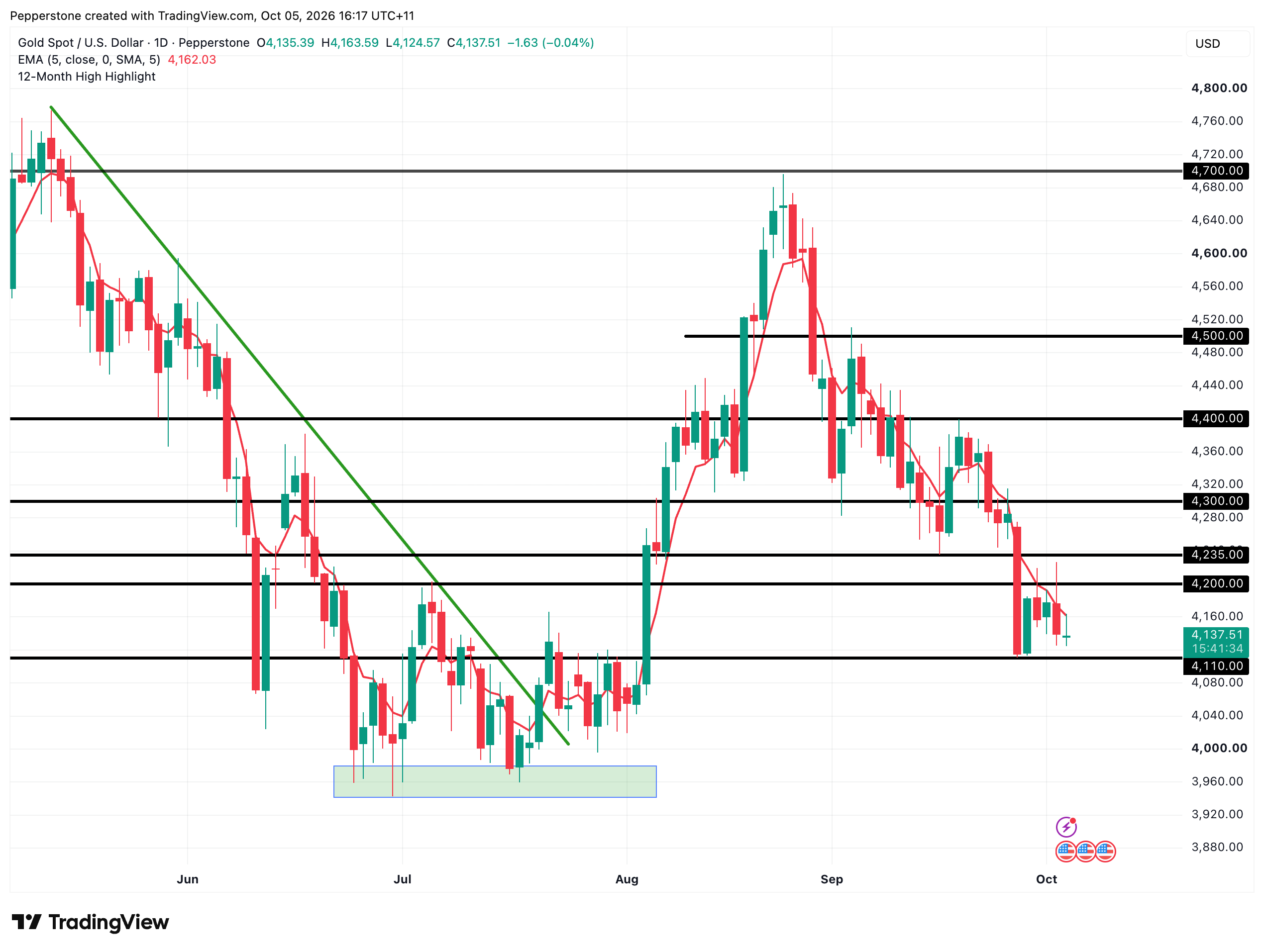
$4,110 is the critical support level right now. A decisive break below it could open the door to further downside, with a test of the $4,000 handle coming into view. On the upside, $4,200 is the first confirmation level for a recovery. If gold can reclaim $4,200 and then push through $4,235, near-term upside could open up, with the next target around $4,300.
Soft Payrolls Fail to Deliver — The Real Pressure Is Coming From Long-End Yields
Friday's payrolls report was almost the ideal script for gold bulls: just 29,000 jobs added, well below the 90,000 consensus; June and July payrolls revised down by a combined 60,000; and the unemployment rate climbing to 4.2%.
For a Fed that had just delivered its first hike in nearly three years weeks earlier, this weak jobs report was clearly a warning sign. After the release, the implied probability of an October hike fell sharply from over 70% to around 14%, and gold briefly rallied.
But that rally reversed the same day, as markets continued to price in a 25 basis point hike by year-end. In other words, the market isn't trading "the end of the hiking cycle" — it's trading "the next hike has been delayed."
For gold, this kind of marginal easing isn't enough to drive sustained buying. What's constraining gold's upside now isn't just short-term policy rate expectations — it's long-end Treasury yields, which a single jobs report can't meaningfully shift.
U.S. federal debt has now crossed $40 trillion, and as Treasury issuance increases, the market's capacity to absorb long-term government debt is coming under scrutiny. As of last week, long-end yields had risen for a fifth straight week, with both 10-year and 30-year Treasury yields hitting their highest levels since 2002, while the 10-year real yield approached 3%.
Compared to short-term rates, long-end yields are driven more by inflation expectations, fiscal deficits, and term premiums. The continued rise in long-end yields has also been supporting the dollar. Against a backdrop of dollar strength and elevated real yields, the opportunity cost of holding a non-yielding asset like gold has risen, naturally weighing on prices.
Geopolitics: The U.S.-Iran Standoff Persists — No Relief for Gold
Tensions in the Middle East escalated further over the weekend. Houthi forces struck targets in Riyadh and at Saudi Aramco facilities; Iran's parliamentary speaker said the Strait of Hormuz will not reopen until seven conditions are met; and Trump has reinforced U.S. military deployments in the region while discussing next steps with his core cabinet.
Although a G7 pledge to release strategic reserves, along with reports of a recovery in Middle East crude exports toward the end of September, briefly eased supply disruption concerns and pushed oil lower on Monday, the geopolitical risk premium is far from gone. If the news flow suddenly deteriorates, higher energy prices could reignite inflation concerns and transmit pressure to gold via Treasury yields.
ETF Inflows Provide a Floor for Gold
Despite elevated Treasury yields and ongoing geopolitical risk weighing on gold, ETF holdings have been rising noticeably. Since July, gold ETF holdings have climbed from roughly 96.5 million ounces to 99 million ounces, even as spot gold has continued to trade within the $4,000–$4,300 range.
This divergence between ETF holdings and the gold price suggests that some capital hasn't meaningfully exited the gold market despite the recent pullback. If these inflows continue, it may indicate that institutional investors are using the price correction as an opportunity to gradually build gold exposure.
If this underlying demand keeps strengthening, whether gold prices eventually catch up to the signal being sent by ETF flows is a potential bullish indicator worth watching closely in the period ahead.
This Week's Core Focus: Can the FOMC Minutes Open Up Room for a Rally?
On the whole, gold remains stuck in a low-level consolidation under the weight of rate pressure. For a genuine near-term turnaround, gold will likely need either an easing in U.S.-Iran tensions that drives a sustained pullback in oil prices, or significant action from the Treasury or the Fed to restore confidence in long-end rates. Until then, the sustainability of any rebound remains in question.
Beyond geopolitical developments, this week's economic calendar is relatively light, though a few risk events could still trigger volatility.
Monday brings the September ISM Services PMI, with consensus at 55, down from 55.4 previously. The prices paid component in the manufacturing PMI has already climbed to 77.9 — if the services PMI shows similarly persistent price pressure, it could prompt markets to reprice the "pause in hikes" narrative that emerged after the weak payrolls data, adding marginal pressure on gold.
More important is Wednesday's FOMC meeting minutes, which markets hope will reveal how much support existed within the committee for a further hike at the September meeting. Even though the latest jobs data wasn't part of that discussion, if the minutes show most officials still leaning toward another hike this year, renewed rate pressure could push gold back toward a test of $4,110.
The 10-year Treasury auction on the same day, along with Friday's University of Michigan consumer sentiment index, are also worth watching, as both could influence the direction of long-end yields and market expectations for the Fed's rate path. If auction demand holds up well with an improved bid-to-cover ratio, and consumer sentiment softens modestly, that could help pull yields lower and offer gold some support.
The material provided here has not been prepared in accordance with legal requirements designed to promote the independence of investment research and as such is considered to be a marketing communication. Whilst it is not subject to any prohibition on dealing ahead of the dissemination of investment research we will not seek to take any advantage before providing it to our clients. Pepperstone doesn’t represent that the material provided here is accurate, current or complete, and therefore shouldn’t be relied upon as such. The information, whether from a third party or not, isn’t to be considered as a recommendation; or an offer to buy or sell; or the solicitation of an offer to buy or sell any security, financial product or instrument; or to participate in any particular trading strategy. It does not take into account readers’ financial situation or investment objectives. We advise any readers of this content to seek their own advice. Without the approval of Pepperstone, reproduction or redistribution of this information isn’t permitted.