- English
- Italiano
- Español
- Français


Why XAUUSD Is Under Pressure and What Traders Should Watch Next

Client activity and interest in XAUUSD has been exceptionally strong, with trading alerts triggered on the break below the 11 June low of $4,023 and again as price fell through the psychologically important $4,000 level.
As it stands, 68% of open XAUUSD positions held by Pepperstone clients are held long and positioned for a potential bounce. While this reflects a wide range of trading styles, holding periods and views, it highlights that many traders continue to believe the recent sell-off will prove temporary and that gold can reclaim levels above $4,000.
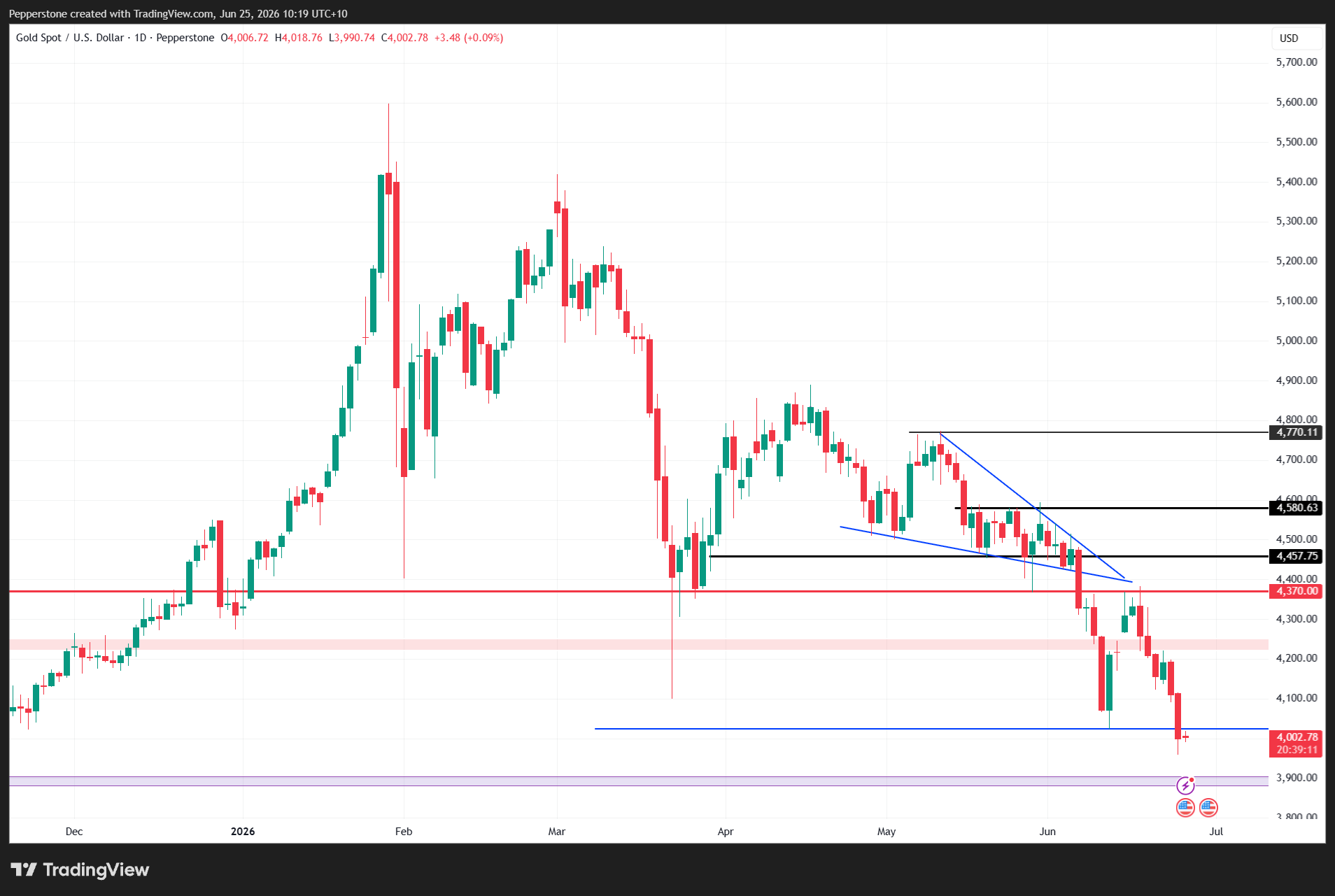
The price action and trend, however, suggests risk of a further move lower…
Momentum traders are increasingly relying on the prevailing short and medium-term downtrend, and the technical picture remains in favour of the sellers. A sustained break and hold below Wednesday's low at $3,959 would likely add further conviction that XAUUSD can extend towards $3,900 and potentially lower.
Price is the ultimate fundamental
There is no stronger driver of market psychology than price itself.
In gold, price action often becomes the dominant fundamental because it influences positioning, sentiment and the behaviour of systematic investors. As prices trend lower, trend-following systematic funds increase short exposure, options dealers dynamically hedge their books by shorting gold futures, and discretionary investors become increasingly reluctant to step in front of the prevailing move. These flows can become self-reinforcing and accelerate the trend.
The question many traders ask is why gold is so out of favour…
While there are always multiple drivers behind gold, one theme increasingly stands out. The investment case for money managers turning materially overweight gold is simply lacking…
Why investment managers are looking elsewhere
Gold has traditionally performed best when it offers portfolio diversification through a low or negative correlation with other major asset classes. With the rolling correlation with NAS100 and S&P500 futures positive and holding a statistically relevant relationship, that diversification benefit has diminished in recent weeks.
During the US-Iran conflict, gold failed to act as an effective geopolitical hedge. Despite sharp moves in crude oil, demand for gold fell sharply, as witnessed by the outflows from the GLD and GDX ETFs – portraying that institutional demand has softened and leaving systematic sellers with relatively little buying interest to absorb supply.
The opportunity cost of owning gold
Another important headwind has been the increasing opportunity cost of holding a non-yielding asset.
The AI investment theme continues to generate exceptional returns across parts of the technology sector, attracting significant flows that might otherwise have been allocated to defensive assets such as gold.
At the same time, US 10-year real Treasury yields (10yr yields adjusted by inflation expectations) have risen to 2.28%, to trading at their highest levels since April 2025. Rising real yields increase the relative attractiveness of interest-bearing assets while reducing the appeal of holding gold, which generates no income.
.png)
Higher real yields have also been a major driver of the recent US dollar breakout. While gold has weakened across most major currencies, suggesting this is fundamentally a gold story rather than simply a stronger US dollar story, the appreciation in the dollar has added another significant headwind.
A hawkish Fed changes the landscape
Monetary policy has also shifted materially.
Under Chair Kevin Warsh, the Federal Reserve's reaction function appears increasingly hawkish. The latest dot plot showed nine of eighteen FOMC members expecting further rate hikes this year, with six projecting cumulative tightening of 50 basis points or more.
The Fed is also reviewing how it communicates policy, with less reliance on forward guidance and greater emphasis on incoming data. That shift is likely to inject greater volatility into front-end interest rate markets and reduce confidence around the outcome of future Fed meetings.
The market is no longer debating when the first rate cut will arrive.
Instead, attention has shifted towards when the next rate hike may occur and how aggressive that tightening cycle could become.
That represents a significant shift for markets.
Higher policy expectations, rising real yields and a stronger US dollar are a challenging combination for gold and have contributed to the unwinding of many of the debasement trades that supported the metal over recent years.
What could support gold?
There are reasons to believe downside risks may become more limited over time.
Positioning in futures markets has become considerably cleaner following the recent correction, reducing some of the excess speculative long exposure that had built previously.
At the same time, global central bank demand remains constructive. Recent surveys show reserve managers continue to view gold favourably as they diversify reserves away from the US dollar, while China's central bank has resumed and accelerated gold purchases in recent months.
Central bank buying has been one of the most important structural pillars supporting gold over the past five years and should continue to provide a longer-term source of demand.
Technical outlook
For now, however, the technical picture remains firmly in favour of the bears.
Price continues to trade below key moving averages and below important support levels. Until XAUUSD can reclaim $4,115, momentum indicators suggest sellers remain in control and rallies are likely to attract fresh selling interest rather than sustained buying.
Ultimately, price remains the best fundamental because it aggregates every opinion, every macro view and every positioning decision into one signal.
At present, that signal continues to favour the downside, although broad positioning is now pulled right back and central banks are making more noise about increasing gold purchases over the coming 12 months.
Should the US dollar continue to strengthen and real yields extend higher, a move towards $3,900 appears increasingly probable before a more durable base can be established.
The material provided here has not been prepared in accordance with legal requirements designed to promote the independence of investment research and as such is considered to be a marketing communication. Whilst it is not subject to any prohibition on dealing ahead of the dissemination of investment research we will not seek to take any advantage before providing it to our clients. Pepperstone doesn’t represent that the material provided here is accurate, current or complete, and therefore shouldn’t be relied upon as such. The information, whether from a third party or not, isn’t to be considered as a recommendation; or an offer to buy or sell; or the solicitation of an offer to buy or sell any security, financial product or instrument; or to participate in any particular trading strategy. It does not take into account readers’ financial situation or investment objectives. We advise any readers of this content to seek their own advice. Without the approval of Pepperstone, reproduction or redistribution of this information isn’t permitted.