• Home
  • Pro
  • Partners
  • Help and support
  • English (UK)
Pepperstone logo
Pepperstone logo
  • Ways to trade
    • CFD trading

      Trade price movements with competitive spreads

    • Spread betting

      Bet on global price movements in £ per point

    • Pricing

      Discover our tight spreads, plus all other possible fees

    • Trading accounts
    • Risk management
    • Demo trading
    • Trading hours
    • US Earnings Season
    • 24-hour trading
    • Maintenance schedule
  • Markets
    • Forex

      Get great rates on majors like EUR/USD, plus minors and exotics

    • Indices

      Enjoy 24-hour pricing on the UK100, US30 and more

    • Commodities

      Trade on metals, energies & softs, with oil spreads from 2 cents

    • Shares
    • ETFs
    • Currency indices
    • Dividends for index CFDs
    • Dividends for share CFDs
    • CFD forwards
  • Trading platforms
    • TradingView

      Trade through the world-famous supercharts with great pricing

    • MetaTrader 5

      Explore the apex in trading automation with our execution tech

    • The Pepperstone platform
    • MetaTrader 4
    • cTrader
    • Trading tools
  • Market analysis
    • Navigating markets

      Latest news and analysis from our experts

    • The Daily Fix

      Your regular round-up of key events

    • Meet the analysts

      Our global team giving your trading the edge

  • Learn
    • Trading guides

      Trading guides & educational materials

    • Webinars

      Grow your knowledge

  • About us
    • Who we are

      Pepperstone was born from the dream of making trading better

    • Pepperstone reviews
    • Press releases
    • Company awards
    • Protecting clients online
    • CFD trading

      Trade price movements with competitive spreads

    • Spread betting

      Bet on global price movements in £ per point

    • Pricing

      Discover our tight spreads, plus all other possible fees

    • Trading accounts
    • Risk management
    • Demo trading
    • Trading hours
    • US Earnings Season
    • 24-hour trading
    • Maintenance schedule
    • Forex

      Get great rates on majors like EUR/USD, plus minors and exotics

    • Indices

      Enjoy 24-hour pricing on the UK100, US30 and more

    • Commodities

      Trade on metals, energies & softs, with oil spreads from 2 cents

    • Shares
    • ETFs
    • Currency indices
    • Dividends for index CFDs
    • Dividends for share CFDs
    • CFD forwards
    • TradingView

      Trade through the world-famous supercharts with great pricing

    • MetaTrader 5

      Explore the apex in trading automation with our execution tech

    • The Pepperstone platform
    • MetaTrader 4
    • cTrader
    • Trading tools
    • Navigating markets

      Latest news and analysis from our experts

    • The Daily Fix

      Your regular round-up of key events

    • Meet the analysts

      Our global team giving your trading the edge

    • Trading guides

      Trading guides & educational materials

    • Webinars

      Grow your knowledge

    • Who we are

      Pepperstone was born from the dream of making trading better

    • Pepperstone reviews
    • Press releases
    • Company awards
    • Protecting clients online
Equities

A Virtuous Cycle For Equities May Be A Vicious One For Labour

Michael Brown
Michael Brown
Senior Research Strategist
20 Apr 2026
Share
Record equity highs continue to diverge from softer economic fundamentals, with rising productivity, limited labour cost growth, and sustained buybacks driving a virtuous cycle for stocks, while reinforcing a more fragile, increasingly K-shaped economic backdrop.

The Stock Market Is Not The Economy

It’s a well-worn adage that ‘the stock market is not the economy’.

Over time, that adage has tended to ring true more often than not. Equities operate as a forward-looking discounting mechanism, pricing expectations of future corporate earnings, as opposed to whatever the economic reality ‘on the ground’ may be in the here and now.

There have, perhaps, seldom been many times where that divergence has been as stark as it is now. Not only from a geopolitical perspective, where major Wall St benchmarks trade at all-time highs, despite conflict continuing to rage, but from an economic one too, with stocks at record highs, while consumer sentiment plumbs record lows, and the labour market remains mired in a ‘no hire, no fire’ dynamic.

So, what’s driving the equity market higher?

Put simply, there seems to be something of a virtuous cycle going on here. Increasingly, it is the case that corporates are able to grow revenues, substantially in some cases, while keeping labour costs largely unchanged, or even reducing them via layoffs, in turn resulting in a lower cost of goods sold, and a higher gross margin. Arguably the only factor that can explain this dynamic is higher productivity, whereby either fewer workers are producing the same level of output, or the same number of workers are producing more output.
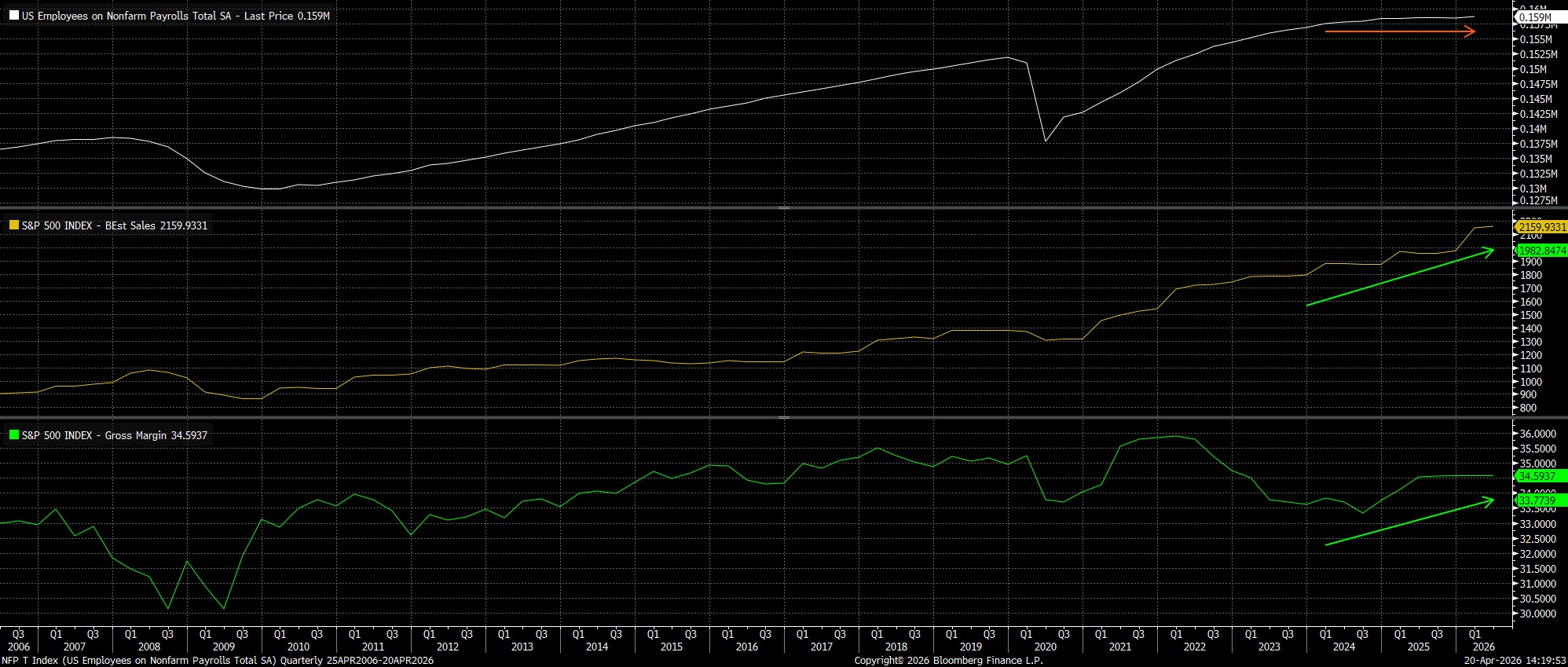
Preview

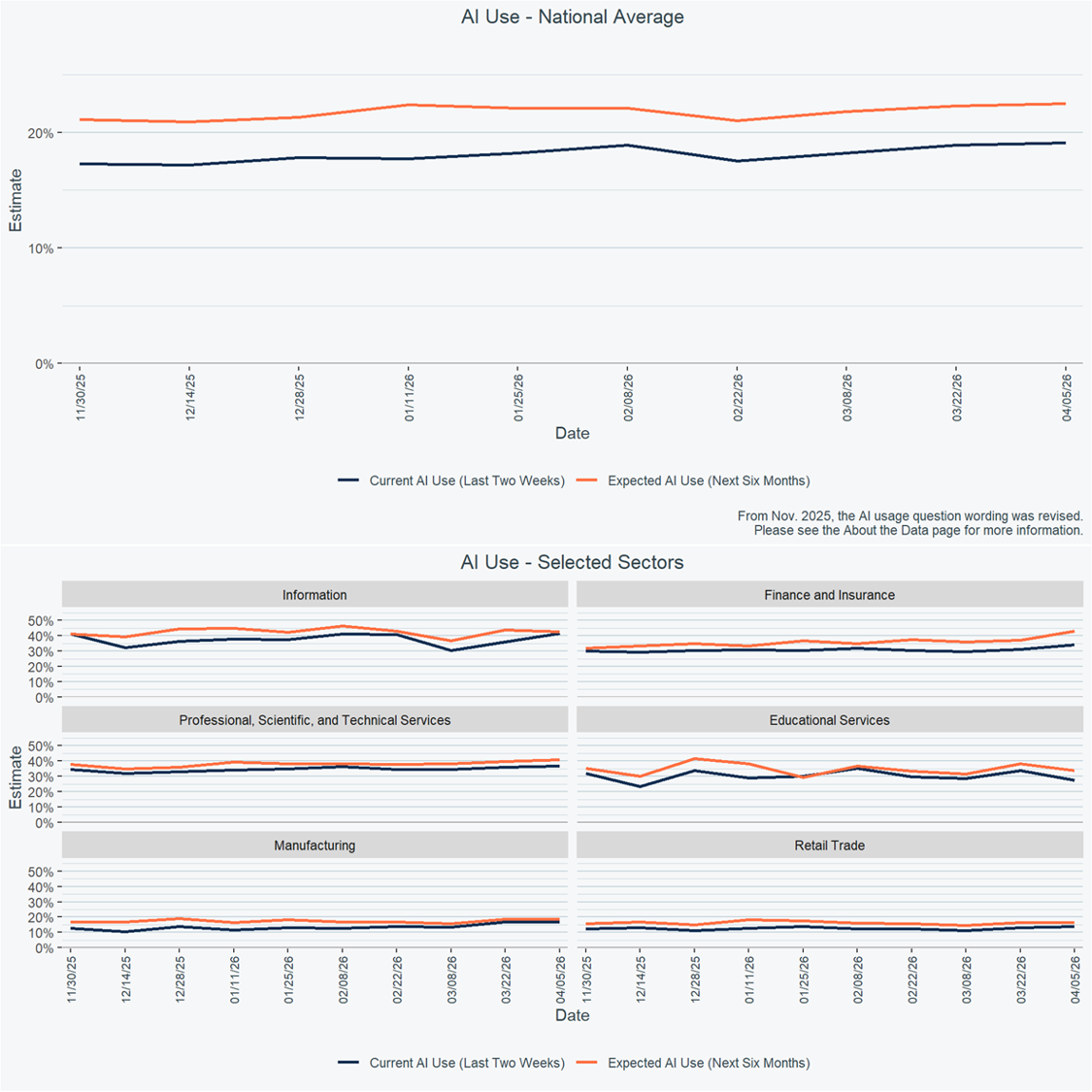
Importantly, this apparent higher productivity is coming, by and large, before the impacts of increased automation, and increased AI adoption, make themselves known.

According to the most recent ‘Business Trends and Outlook Survey’, from the US Census Bureau, only around 20% of respondents noted that their business had used AI in any function over the last two weeks, while around 23% noted that the planned to do so in the next six months. While AI adoption varies considerably across sectors, with almost half of Finance and Insurance businesses surveyed having adopted AI already, compared to around 10% of Retail firms, the overall picture being painted here is one where AI adoption has significantly more room to run, in turn allowing the aforementioned virtuous cycle that is currently driving the market, to continue doing so.
Preview

Buybacks Play A Role Too

Concurrently, there is increasingly a shortage of stock that is actually available for investors to buy.

Across the board, corporates have ramped-up buybacks in recent years and, while I view this as one of the most inefficient conceivable uses of capital, the amount of stock being bought back shows no sign of slowing. The total S&P 500 buyback topped $1tln in 2025, with this year likely to see a similarly strong pace of corporate repurchases. Going back to our ‘Economics 101’ textbooks, we know that, all else equal, if the supply of a good (in this case a stock) were to decline, and demand to remain unchanged, or even increase, a higher price of the good, or stock, in question is the ultimate result. Again, as the pace of buybacks continues, so does the equity market’s virtuous cycle.

Preview

A Net Negative For Employment

While all this marks a ‘virtuous cycle’ for equities, which looks set to continue for some time, one could argue that it marks something of a ‘vicious cycle’ for employees.

This isn’t a particularly groundbreaking take, but as productivity increases, either as a result of AI, or some other factor, corporates are likely to operate somewhat leaner business models, with lower headcount. Already, the labour market backdrop is a relatively fragile one, with a broader shift to such a model likely to further embed the already-lacklustre nature of labour demand.
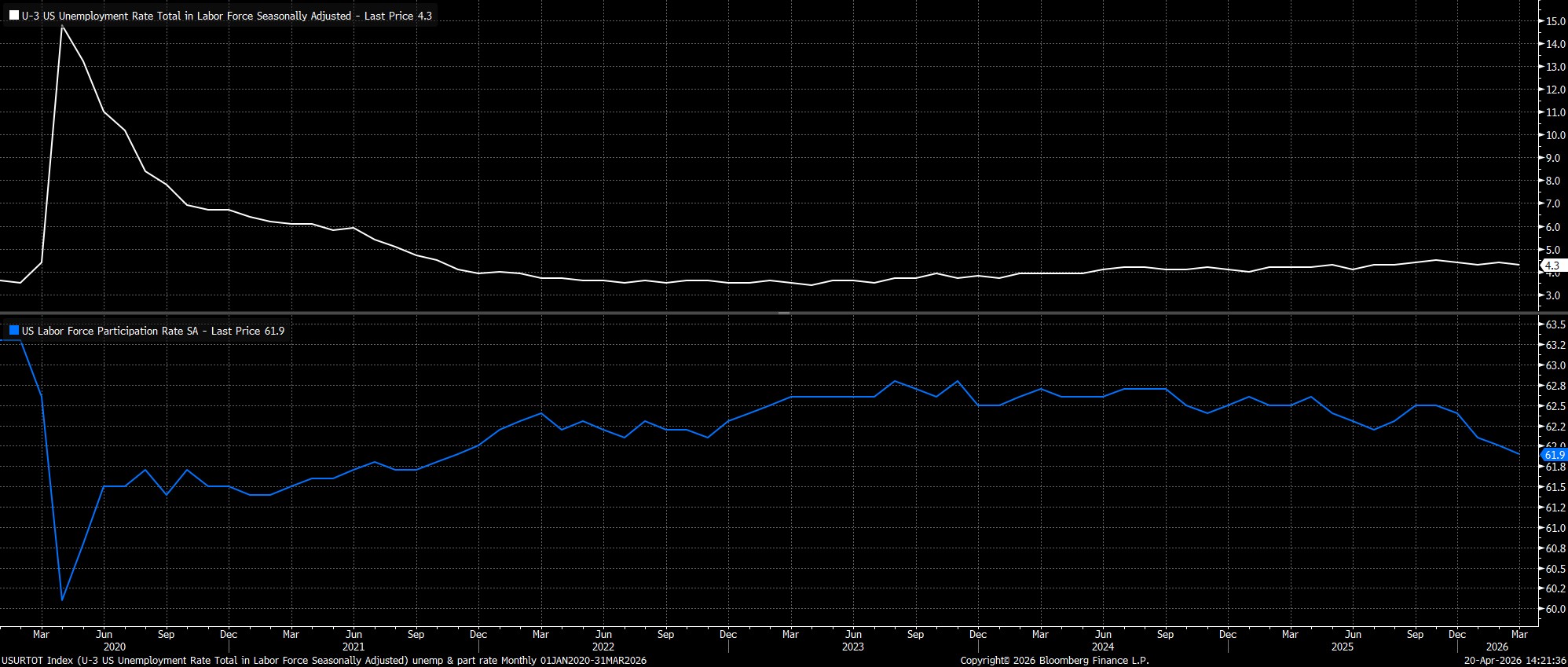
Preview

Perpetuating The 'K-Shaped' Economy

Taking this a step further, it seems plausible that, together, these two factors – a virtuous cycle for stocks, and a vicious one for employment – will further perpetuate the idea of a ‘K-shaped’ US economy.

To recap, this is one where those who own assets, either property or stocks, sit in the top part of the ‘K’, benefitting from a positive wealth effect, and in turn largely propping up overall personal consumption. Simultaneously, those in the lower part of the ‘K’, who tend not to be asset owners, experience a very different economy, whereby the weak employment backdrop has a much more detrimental impact on consumption. Of course, ballooning government deficits, and a monetary policy framework which has implicitly accepted 2% inflation as a floor not a ceiling, don’t help matters much on this front.

Summing up, it’s clear that the stock market is not the economy; in many ways, for the sake of equity bulls, it’s just as well that that is the case.

The material provided here has not been prepared in accordance with legal requirements designed to promote the independence of investment research and as such is considered to be a marketing communication. Whilst it is not subject to any prohibition on dealing ahead of the dissemination of investment research we will not seek to take any advantage before providing it to our clients. Pepperstone doesn’t represent that the material provided here is accurate, current or complete, and therefore shouldn’t be relied upon as such. The information, whether from a third party or not, isn’t to be considered as a recommendation; or an offer to buy or sell; or the solicitation of an offer to buy or sell any security, financial product or instrument; or to participate in any particular trading strategy. It does not take into account readers’ financial situation or investment objectives. We advise any readers of this content to seek their own advice. Without the approval of Pepperstone, reproduction or redistribution of this information isn’t permitted.

Other Sites

  • The Trade Off
  • Partners
  • Group
  • Careers

Ways to trade

  • Pricing
  • Trading accounts
  • Pro
  • Trading hours

Platforms

  • Trading platforms
  • TradingView
  • MT5
  • MT4
  • cTrader
  • Trading tools

Markets and Symbols

  • Forex
  • Shares
  • ETFs
  • Indices
  • Commodities
  • Currency indices
  • CFD forwards

Analysis

  • Navigating markets
  • The Daily Fix
  • Meet our analysts
  • Trading guides
  • Videos
  • Webinars

About

  • Press releases
  • Security vulnerability disclosure
Pepperstone logo
support@pepperstone.com
+448000465473+442038074724
70 Gracechurch St
London EC3V 0HR
United Kingdom
  • Legal documents
  • Privacy policy
  • Website terms and conditions
  • Cookie policy
  • Sitemap

© 2025 Pepperstone Limited
Company Number 08965105 | Financial Conduct Authority Firm Registration Number 684312

Risk warning: Spread bets and CFDs are complex instruments and come with a high risk of losing money rapidly due to leverage. 73% of retail investor accounts lose money when trading spread bets and CFDs with this provider. You should consider whether you understand how spread bets and CFDs work and whether you can afford to take the high risk of losing your money.

Trading derivatives is risky. It isn't suitable for everyone and, in the case of Professional clients, you could lose substantially more than your initial investment. You don't own or have rights in the underlying assets. Past performance is no indication of future performance and tax laws are subject to change. The information on this website is general in nature and doesn't take into account your or your client's personal objectives, financial circumstances, or needs. Please read our legal documents and ensure you fully understand the risks before you make any trading decisions. We encourage you to seek independent advice.

Pepperstone Limited is a limited company registered in England & Wales under Company Number 08965105 and is authorised and regulated by the Financial Conduct Authority (Registration Number 684312). Registered office: 70 Gracechurch Street, London EC3V 0HR, United Kingdom.

The information on this site is not intended for residents of Belgium or the United States, or use by any person in any country or jurisdiction where such distribution or use would be contrary to local law or regulation.