- English (UK)


Gold Outlook: Repeated Geopolitical Swings Keep Gold Awaiting a Breakout
.jpg?height=93&quality=100)
Over the past week, gold has remained range-bound at elevated levels. In the near term, markets have swung between “risk-on relief” and “conflict escalation” pricing, leaving gold caught between rate-driven headwinds and growth-hedging demand, with little clear directional conviction.
Looking ahead into this week, traders will focus primarily on developments in the Middle East as well as shifting expectations around Fed’s rate path. Both are likely to drive meaningful volatility in gold prices.
Technical Observation: Another Gap-Up Recovery, Range Structure Intact
From the XAUUSD daily chart structure, gold’s corrective uptrend since late March remains intact, with prices posting gains for a fourth consecutive week.
However, last week’s 1.8% advance was largely concentrated in the first two trading sessions, with momentum fading thereafter. Price action has since remained confined within the $4,740–$4,900 range.
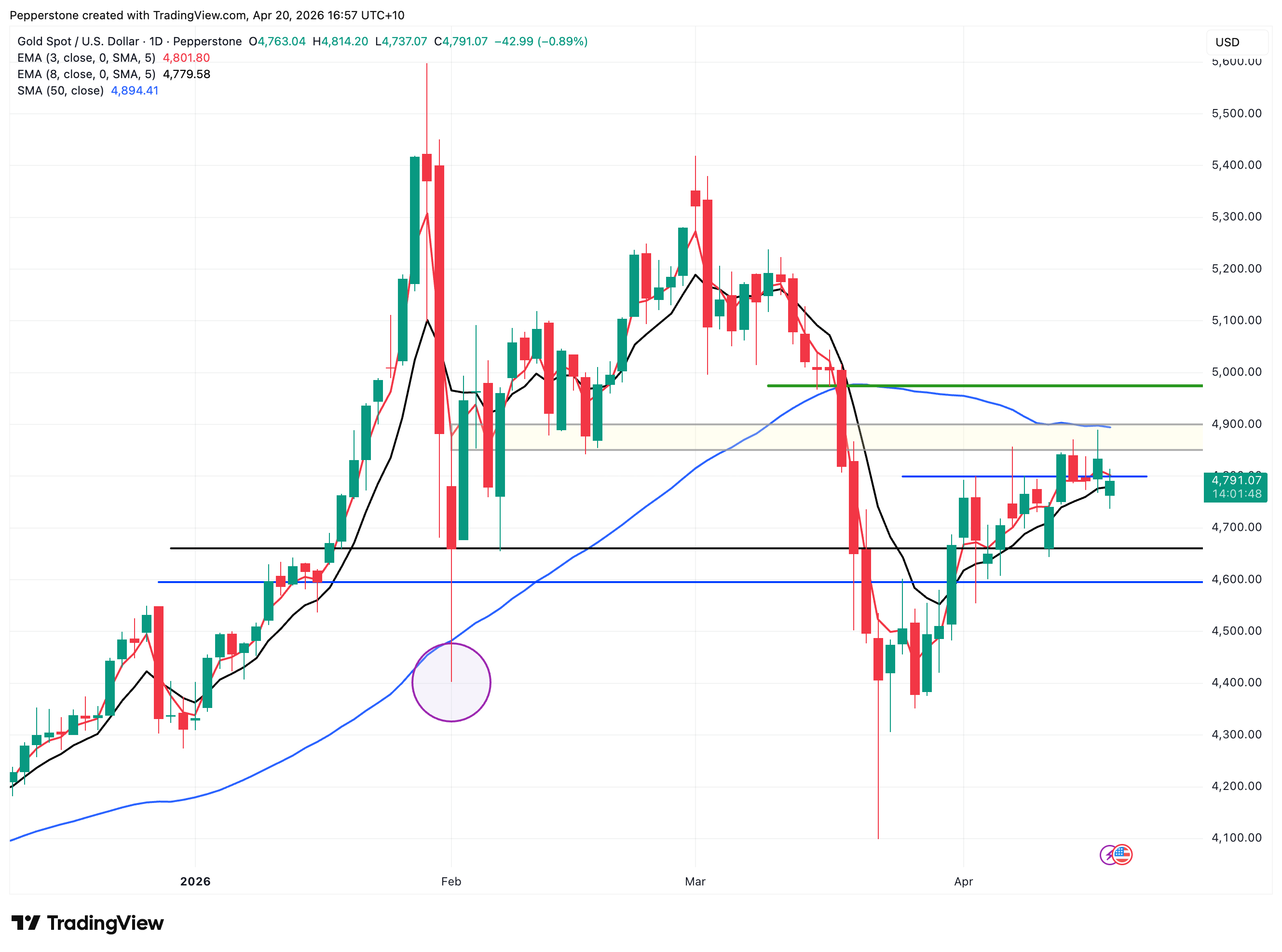
Driven by renewed geopolitical headlines, the market opened this week with another gap-down followed by a rebound, similar to the pattern seen the previous Monday, with price once again testing the $4,800 level.
If a breakout is achieved, the $4,850–$4,900 region (near the 50-day moving average) is likely to remain a key resistance zone. On the downside, a break below $4,700 would weaken the short-term structure, opening the door to a deeper pullback toward $4,660 and potentially $4,550.
“Peace Story” Remains Fragile, Capping Gold’s Upside
The primary driver behind Monday’s gap lower was a rapid shift in sentiment from “conflict de-escalation pricing” back to “conflict escalation pricing.”
On Friday, US signaled that a deal was close to completion, while Iran stated that the Strait of Hormuz had been fully reopened to commercial shipping during the ceasefire. This boosted risk sentiment, briefly pushing gold toward the $4,900 level.
However, the optimism lasted less than 24 hours. Over the weekend, conditions reversed: Iran reinstated restrictions on the Strait, US forces engaged and detained Iranian commercial vessels in the Gulf of Oman, and Iran responded with drone activity. In addition, Tehran reiterated that it would not transfer enriched uranium and demanded full sanctions relief, further reducing the likelihood of a near-term agreement.
This “two steps forward, one step back” dynamic has increased the market’s geopolitical risk premium. It has simultaneously lifted energy supply risk and inflation concerns, while reinforcing USD safe-haven flows and hawkish rate repricing—together limiting gold’s upside potential.
Growth Expectations and Central Bank Buying: Underlying Support Remains
Despite short-term pressure, gold continues to hold within a high trading range, reflecting notable downside resilience.
Markets have gradually developed a degree of “absorption capacity” toward repeated geopolitical and policy-driven headlines, reducing the marginal impact of sentiment swings on price.
At the same time, while “hard data” in the economy remains broadly resilient and inflation has yet to fully broaden beyond energy, persistent energy cost pressures are increasingly weighing on household consumption and corporate earnings.
Should upcoming labour market and consumption data show clearer signs of weakness, expectations for slowing growth could strengthen, reviving rate-cut pricing. In that scenario, gold’s role as a hedge could regain support from capital flows.
Meanwhile, sustained central bank gold buying continues to provide a structural floor for prices over the medium to long term, limiting the likelihood of a deeper trend reversal.
Two Key Variables Shaping the Near-Term Outlook
Overall, gold has remained range-bound over the past week amid fluctuating geopolitical headlines. From current developments, core disagreements over nuclear issues and control of the Strait of Hormuz remain far from resolution.
As the ceasefire approaches expiration, the situation is more likely to evolve into a prolonged standoff characterised by low-intensity conflict and diplomatic stalemate.
This implies that gold will likely continue oscillating between safe-haven demand and reflation-driven pricing. Unless there is a material de-escalation in geopolitical tensions, or price action achieves a decisive break above $4,900, the broader market structure is expected to remain range-bound.
Going forward, two key variables will dominate sentiment: first, post-ceasefire developments in the Middle East, including shipping security and access through the Strait of Hormuz; and second, the Fed’s balancing act between inflation and growth.
On the geopolitical front, the two-week ceasefire agreement is set to expire on April 22, leaving less than 48 hours. Reports suggest US representatives have travelled to Pakistan, while Iran has refused to engage in a second round of talks. Any marginal development could trigger short-term volatility, but without resolution of core disagreements, gold is unlikely to establish a clear trend.
On the policy side, US retail sales and initial jobless claims will be key data points. A downside surprise could reinforce expectations of broader economic cooling, potentially strengthening gold’s safe-haven demand and providing near-term support.
Meanwhile, the Senate hearing for Kevin Warsh’s nomination as Fed Chair on April 21 adds another layer of uncertainty. With less than a month remaining in Powell’s term and ongoing legal scrutiny, the nomination process itself may become a new source of volatility. Should Warsh ultimately be confirmed, his relatively dovish policy stance could provide marginal support for gold.
In summary, headline-driven volatility is likely to remain elevated in the near term, and risk management will remain critical for navigating short-term price swings.
The material provided here has not been prepared in accordance with legal requirements designed to promote the independence of investment research and as such is considered to be a marketing communication. Whilst it is not subject to any prohibition on dealing ahead of the dissemination of investment research we will not seek to take any advantage before providing it to our clients. Pepperstone doesn’t represent that the material provided here is accurate, current or complete, and therefore shouldn’t be relied upon as such. The information, whether from a third party or not, isn’t to be considered as a recommendation; or an offer to buy or sell; or the solicitation of an offer to buy or sell any security, financial product or instrument; or to participate in any particular trading strategy. It does not take into account readers’ financial situation or investment objectives. We advise any readers of this content to seek their own advice. Without the approval of Pepperstone, reproduction or redistribution of this information isn’t permitted.