- English (UK)


Microsoft Q1 26 Earnings Review: A Clean Beat, but Profitability Draws Scrutiny
.jpg?height=93&quality=100)
Microsoft reported its fiscal third-quarter results after the bell on April 29. On paper, it was about as clean a beat as you could ask for — revenue, EPS, and operating income all came in ahead of consensus, while Azure and Copilot growth helped ease the market's lingering concerns about a cloud slowdown.
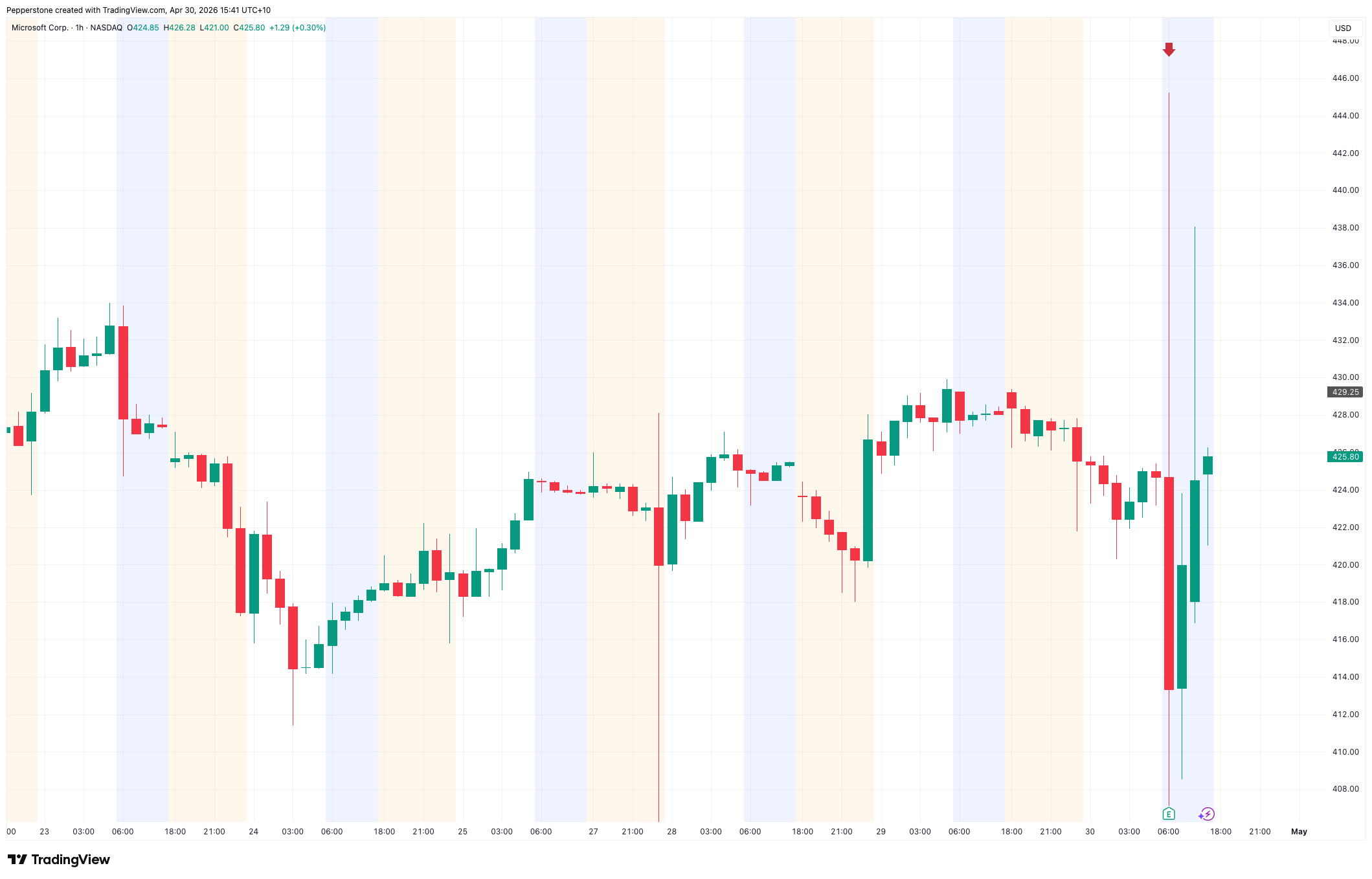
And yet, shares fell as much as 3% in after-hours trading. Because what traders are really asking isn't how last quarter went — it's where margins go from here, with the AI investment cycle nowhere near its peak.
Azure Reaccelerates, but the Bar for "Upside" Keeps Rising
Azure's 40% growth was the headline number of the quarter. After two consecutive quarters of deceleration that had the market questioning the cloud thesis, Microsoft is back on the right side of the trend. The Q2 outlook — 39% to 40% growth — came in ahead of some sell-side estimates, adding a constructive forward signal.
That said, the number cuts both ways. On the positive side, CFO Amy Hood had previously flagged that capacity constraints would persist through the end of FY26 (i.e., calendar Q2 2026). A 40% print under those conditions suggests underlying demand could be even stronger than the reported figure implies.
On the other hand, Google Cloud grew roughly 63% in the same period. The competitive gap hasn't closed — if anything, it's widened. The market share Microsoft ceded during its data center missteps won't be recaptured overnight.
For traders, the key takeaway is that the definition of "upside" on Azure has quietly shifted. The incremental positive surprise is getting smaller, and so is its contribution to share price moves.
Copilot Momentum Is Real, but Monetization Is Still Early
The other standout came from the AI product line. Copilot added 5 million net new paid seats in the quarter — its fastest growth on record. AI annualized revenue was up 123% year-over-year, and the Productivity segment posted $35 billion in revenue, topping estimates by roughly $600 million.
The acceleration confirms that enterprise adoption is genuine — AI productivity tools are moving from evaluation to budget approval. With Microsoft's price increase for Microsoft 365 and Office taking effect on July 1, and Copilot continuing to expand into education and consumer markets, the revenue trajectory should remain favorable near-term.
That said, 20 million paid seats against a base of 400 million commercial subscribers puts penetration at roughly 5%. Copilot's contribution to actual earnings remains limited for now — it's supporting the valuation narrative more than it's driving current-period profits.
Heavy Capex Is Compressing the Margin Picture
Even as Azure and Copilot demonstrate real monetization potential, the company's capital spending plans remain a meaningful overhang for bulls.
On the earnings call, management raised its full-year capex guidance to $190 billion — nearly $35 billion above prior consensus. Roughly $25 billion of that reflects higher memory costs driven by tight global supply.
The margin implications are hard to ignore. Q2 operating margin guidance came in at approximately 44%, below the 44.6% analysts had penciled in, and this quarter's gross margin of 67.6% was the lowest since 2022.
The depreciation cycle has only just begun, and the full weight of prior infrastructure buildout has yet to flow through the income statement. Balancing aggressive capacity expansion with margin recovery isn't something Microsoft can do at the same time, at least not in the near term.
The OpenAI Renegotiation: Near-Term Benefit, Long-Term Moat Erosion
Just ahead of earnings, Microsoft and OpenAI renegotiated their partnership: Microsoft will no longer pay revenue share to OpenAI; instead, OpenAI pays Microsoft. On paper, that's a favorable shift for Microsoft's P&L.
The trade-off is that Microsoft gave up its exclusive rights to OpenAI's models and technology. OpenAI is now free to work with other cloud providers, and Azure's position as the default home for OpenAI's infrastructure is no longer guaranteed.
Given that Microsoft has outsourced virtually all of its frontier AI capability to OpenAI — and lacks both a proprietary large language model and a competitive AI chip — the erosion of exclusivity raises a pointed question: once you remove the OpenAI lock-in, what exactly is Azure's AI differentiation built on?
From Growth to Earnings: The Re-Rating Question
Microsoft delivered a strong quarter. Azure and Copilot are increasingly substantiating the AI monetization thesis, and the beat across key metrics gives the bulls something to work with.
But near-term, whether the stock sustains its recovery depends on how quickly the market is willing to believe in the "capacity unlocks → Azure reaccelerates → margins recover" sequence. If next quarter brings continued margin compression and another capex surprise, questions about capital allocation discipline will be difficult to contain.
Longer term, the more important question may be whether Microsoft can build meaningful AI self-sufficiency — stronger in-house model capability, a more competitive silicon roadmap — to reduce its dependence on third parties and improve the economics of each dollar spent. How the company navigates the tension between aggressive AI investment and durable profitability will likely be the defining variable for where this stock re-rates.
Related articles


The material provided here has not been prepared in accordance with legal requirements designed to promote the independence of investment research and as such is considered to be a marketing communication. Whilst it is not subject to any prohibition on dealing ahead of the dissemination of investment research we will not seek to take any advantage before providing it to our clients. Pepperstone doesn’t represent that the material provided here is accurate, current or complete, and therefore shouldn’t be relied upon as such. The information, whether from a third party or not, isn’t to be considered as a recommendation; or an offer to buy or sell; or the solicitation of an offer to buy or sell any security, financial product or instrument; or to participate in any particular trading strategy. It does not take into account readers’ financial situation or investment objectives. We advise any readers of this content to seek their own advice. Without the approval of Pepperstone, reproduction or redistribution of this information isn’t permitted.